
A Practical Guide to Designing Memory Systems That Actually Work
AI agents do not usually fail because they lack memory files. They fail because their memory architecture is badly designed.
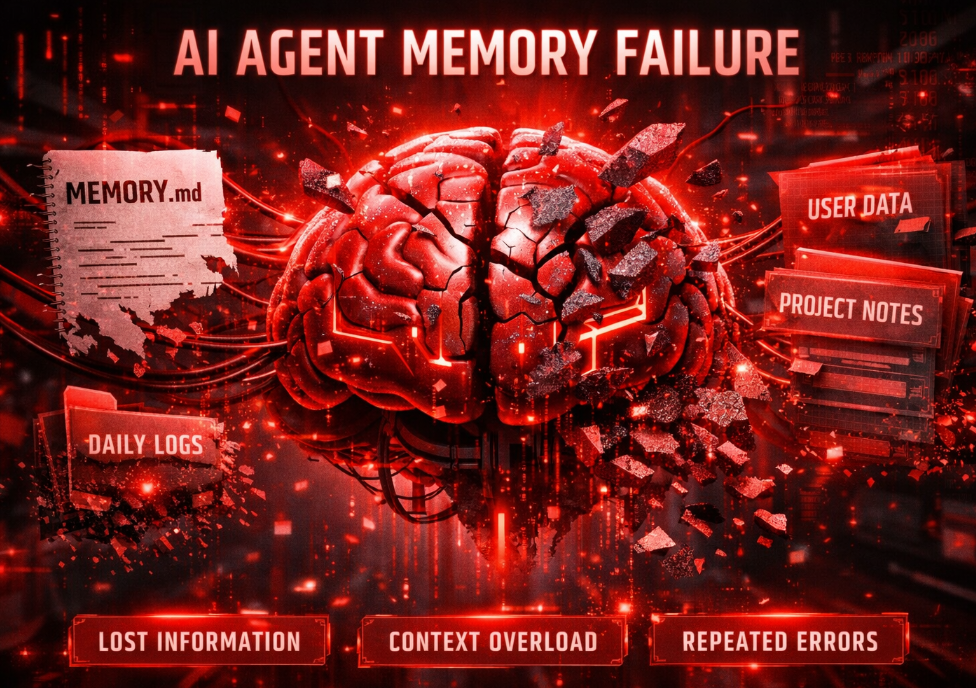
Many builders assume that once information is written into MEMORY.md, daily logs, preference files, or project notes, the agent now “remembers” it. That assumption is wrong. In practice, most agent memory systems are not optimized for retrieval, contextual relevance, or token efficiency. They are optimized for storage. And storage is not memory.
This distinction matters. A memory system is not defined by how much information it can accumulate. It is defined by how reliably it can surface the right information, at the right time, at an acceptable cost. If the agent repeatedly misses known preferences, reloads irrelevant context, re-solves already solved problems, or burns tokens on memory it does not use, then it does not have a memory system. It has a diary.
This article explains why most agent memory systems degrade into “amnesia machines,” what the common architectural failure modes look like, and how to design a layered, retrieval-oriented memory architecture that is actually usable in production.
The Core Problem: Storage Is Easy, Retrieval Is Hard
The first mistake most builders make is conflating persistence with recall.
Saving information is trivial. Retrieving the correct information under real-world constraints is not.
A large memory file may look impressive on disk, but that does not mean it is operationally useful. The relevant questions are more demanding:
- Can the agent find the needed information quickly?
- Can it load only what is relevant to the current task?
- Can it avoid polluting the context window with stale or low-value memory?
- Can it preserve important nuance without constant summarization drift?
- Can it maintain continuity across sessions without excessive startup cost?
If the answer to these questions is no, then the memory system is functionally broken, even if every past conversation has been archived perfectly.
In other words, the quality of an agent’s memory is not determined by how much it stores. It is determined by its retrieval precision, context relevance, token efficiency, and failure rate under load.
Why Monolithic Memory Files Fail
The default architecture for many AI agents is a single long MEMORY.md file containing everything: user preferences, project notes, decisions, reminders, relationships, task history, and distilled lessons. This design is appealing because it is simple. It is also structurally weak.
A monolithic memory file creates several failure modes at once.
First, it increases startup cost. As the file grows, the agent spends more tokens loading information that is often unrelated to the current session.
Second, it reduces retrieval quality. Important facts become buried beneath irrelevant entries, making it harder for the agent to locate signal inside noise.
Third, it blurs semantic boundaries. User preferences, strategic decisions, operational procedures, and transient notes all coexist in one undifferentiated stream. That makes both maintenance and retrieval worse.
Fourth, it encourages passive accumulation rather than active curation. Builders keep appending. They rarely redesign.
The result is predictable: the file becomes a historical archive rather than an operational memory layer. It may preserve the past, but it does not reliably support the present.
Why Daily Logs Alone Are Not Enough
The next common design is a set of daily files such as memory/YYYY-MM-DD.md. This is better for chronology, but still weak for retrieval.
Daily logs are useful as raw records. They preserve what happened and when it happened. They are good for append-only workflows and auditability. But they impose a temporal structure on problems that are usually semantic.
Agents and humans do not usually ask, “What happened on Tuesday?” They ask, “What did we decide about the onboarding workflow?” or “How does this user prefer reports formatted?” or “What was the resolution to the API authentication issue?”
Those are topic-based retrieval questions, not date-based retrieval questions.
A memory system organized purely by time forces the agent to reconstruct topic continuity across multiple files. That increases search cost, increases the chance of omission, and makes startup relevance harder to optimize.
Daily logs are valuable, but only as a low-level archival layer. They should not be mistaken for a complete memory architecture.
The Hidden Failure Mode: Context Window Truncation
Even well-organized memory files can fail for a more basic reason: they do not fully enter the context window.
This is one of the least discussed and most important structural problems in agent design. Builders often assume that if a file exists and is referenced during boot, then the agent has “loaded” it. In reality, the context window imposes hard capacity constraints. When instructions, tools, conversation history, system rules, and memory layers compete for space, some content is truncated, compressed, or omitted.
This omission is not neutral.
Information placed earlier in the loading order is more likely to survive than information loaded later. Information at the top of a file is more likely to survive than information at the bottom. Recent and high-priority content usually receives structural preference. Long-tail details are the first to disappear.
That means the operational identity of the agent is not defined by what exists in its files. It is defined by what actually survives context loading.
This is why many agents exhibit a dangerous behavior pattern: they operate confidently on partial memory without realizing what has been lost. A human often experiences forgetting as a gap. An agent may not. It may continue acting with full fluency while missing decisive context.
From a systems perspective, this is worse than ordinary forgetting. It is unobserved memory degradation.
The Difference Between a Diary and a Memory System
A diary records. A memory system retrieves.
A diary is optimized for appending new information. A memory system is optimized for surfacing the right information under decision pressure.
This distinction is fundamental. Many agent builders believe they have solved memory because they have written enough files. They have not. They have solved persistence, not recall.
A true memory system must satisfy four operational criteria:
First, retrieval relevance. The memory loaded into context should have a high probability of being useful in the current session.
Second, token efficiency. The startup cost of loading memory must be low enough that the system remains economically and computationally viable.
Third, cross-session continuity. Important knowledge must remain reliably accessible across days, not just within the same temporal cluster.
Fourth, low failure rate. When the agent needs context, the system should supply it consistently rather than forcing re-discovery.
If these criteria are not being measured, then the architecture is being evaluated by intuition rather than performance.
The Four Memory Architectures Most Builders End Up Testing
In practice, memory design often evolves through four increasingly mature stages.
1. Single File Memory Architecture
This is the most common starting point. Everything is stored in one long-term memory file. It is easy to implement, easy to understand, and easy to maintain in the short term.
Its weakness is scale. As soon as the file becomes large, retrieval quality drops, startup token cost rises, and important information becomes diluted by irrelevant detail.
The single-file approach is not wrong because it stores too much. It is wrong because it offers no principled retrieval strategy.
2. Daily Log Architecture
The second stage is often to move from one giant file to one file per day. This improves temporal traceability and can reduce some local clutter.
Its weakness is fragmentation across time. Topic continuity becomes difficult to reconstruct. Cross-day user preferences, project states, and decisions become expensive to retrieve.
This architecture solves accumulation pressure but not semantic access.
3. Curated Long-Term Memory Plus Daily Logs
This is a meaningful improvement. The daily files function as raw logs, while a separate MEMORY.md file stores distilled preferences, decisions, and lessons.
This creates a clean separation of concerns. Daily files are write-optimized. Long-term memory is read-optimized.
The problem is that curation becomes its own workload. Summaries drift. Important nuance gets compressed away. The long-term file grows unless someone actively governs it.
4. Layered Memory With Topic Indices
This is usually the most effective architecture.
A small core memory file contains identity-critical information: active projects, stable preferences, critical behavioral constraints, current priorities, and likely retrieval paths. Separate topic files hold subject-specific context such as projects, people, decisions, procedures, or technical environments. Daily logs remain as raw archives for backtracking and forensic recovery.
This design works because it introduces selective loading. The agent always loads the compact core, and only loads topic files when the task justifies them.
It is not elegant because it stores more. It is effective because it retrieves less, more accurately.
What a Good Memory Architecture Actually Optimizes For
A mature memory architecture does not optimize for completeness. It optimizes for precision under constraint.
That means a good design should aim for:
- a small always-loaded core memory layer
- topic-specific modular files
- append-only raw logs for history
- periodic curation rather than constant summarization
- explicit token budgeting
- retrieval decisions based on task relevance
- structural redundancy for critical facts
- verification that important memory actually loaded
This is the point many builders miss. Memory quality is not about how much the agent “knows.” It is about how much useful knowledge the agent can operationalize per session.
The ideal system is not the one with the most data. It is the one with the highest ratio of useful loaded context to total loaded context.
That ratio can be called context relevance. It is one of the most useful metrics in memory design.
If an agent loads 4,000 tokens of memory and uses only 800 of them, then 80 percent of that startup context was waste. That is not just inefficient. It actively competes with the rest of the context window.
The Failure Modes Nobody Talks About Enough
Summarization Drift
Every act of summarization is a compression event. Compression saves tokens but destroys detail.
If a memory item is repeatedly summarized over multiple review cycles, its wording may become cleaner while its meaning becomes less faithful. The agent may retain a polished abstraction and lose the original nuance that made the memory useful.
This is dangerous because summarization drift is often invisible. The memory still looks coherent, but it no longer accurately reflects source reality.
The correct response is not to avoid summarization entirely, but to treat it as a lossy transformation that requires governance.
Recency Bias in Curation
When reviewing recent logs and deciding what to promote into long-term memory, agents and humans alike tend to overweight recent events. Older but still relevant knowledge is more likely to be pruned, ignored, or deprioritized.
This creates a distorted memory surface where the freshest information appears most important regardless of actual long-term value.
A strong mitigation is to separate addition from deletion. New entries can be promoted during one session, but pruning decisions should occur later, under different context conditions.
Bootstrap Retrieval Failure
An agent often needs to know which topic file to load before it fully understands the current request. But it cannot always infer the topic correctly until the conversation has begun. This creates a retrieval paradox.
The solution is usually probabilistic rather than perfect. A compact core memory can contain active projects, likely topics, current user priorities, and recent themes. That gives the system a useful starting bias without forcing full loading of every memory domain.
No architecture completely removes this problem. It can only reduce it.
Silent Truncation
If memory files are loaded after large system prompts, tool definitions, or long conversation histories, the lower-priority content may be silently cut. This means critical information can exist in the workspace but not in the agent’s active working memory.
This is why front-loading matters so much. The first lines of a file are structurally more valuable than the last lines.
The Most Practical Design Pattern: Layered Memory
For most serious agent workflows, the most robust approach is a layered architecture with explicit retrieval tiers.
Tier 1: Core Memory
This file should always be loaded. It must remain small, stable, and strategically curated.
It should contain:
- core user preferences
- active projects
- critical behavioral rules
- essential identity and operating assumptions
- likely topic pointers
- high-priority reminders
A useful discipline is to keep this file small enough that every line must justify its cost.
Tier 2: Topic-Specific Files
These files should be loaded only when relevant.
Examples include:
memory/projects.mdmemory/people.mdmemory/decisions.mdmemory/technical.mdmemory/workflows.md
These files allow deeper continuity without contaminating every session with irrelevant detail.
Tier 3: Daily Raw Logs
These files serve as append-only archives. They are useful for backtracking, auditing, and reconstructing how a decision emerged.
They should not be treated as startup memory. Their value is forensic, not primary.
Operational Best Practices for Agent Memory Systems
A production-ready memory system should follow several rules.
Critical information should be front-loaded. The most important instructions, facts, and preferences must appear near the top of high-priority files.
Core memory should be aggressively compressed, but not repeatedly re-summarized without source checking.
Topic files should emerge on demand. If a subject accumulates enough repeated context, it deserves its own retrieval surface.
Redundancy should be deliberate. Mission-critical preferences or decisions may appear in more than one layer if the retrieval risk justifies the duplication.
Memory loading should be verified. The system should not assume that because a file exists, it is present in active context. It should check.
Startup memory should be ruthlessly audited. If a memory block is loaded often and used rarely, it does not belong in the startup path.
Builders should also track a small set of metrics:
- memory failure rate
- startup token cost
- context relevance
- topic retrieval accuracy
- summarization revision count
- repeat-error incidence
Without metrics, memory design becomes aesthetic rather than operational.
How to Measure Whether a Memory System Actually Works
Most builders never quantify performance. They rely on anecdotal confidence. That is a mistake.
A memory system should be measured on at least four dimensions.
Failure rate: how often the agent needed context and did not have it.
Wasted context rate: how often the agent loaded memory it did not use.
Cross-session continuity rate: how often preferences, decisions, and project state were correctly carried forward.
Repeat mistake frequency: how often the agent re-solved a problem that had already been documented.
These metrics are far more informative than raw file size or number of stored entries.
A memory architecture that stores everything but retrieves poorly is not strong. It is merely large.
The Harsh Truth: Most Agent Memory Systems Are Performing Memory, Not Delivering It
There is an uncomfortable but necessary conclusion here.
Many AI agents are not designed to remember important things. They are designed to create the appearance of remembering. That appearance is often enough to fool the builder.
A huge MEMORY.md file creates a sense of continuity. Daily logs create a sense of history. Archived summaries create a sense of persistence. But unless the system is measured for retrieval quality, failure rate, and context efficiency, those artifacts may be cosmetic.
This is why so many agents quietly degrade. They miss preferences that were already recorded. They repeat mistakes that were already solved. They load irrelevant context while dropping decisive facts. They burn tokens maintaining the illusion of continuity instead of engineering actual recall.
Writing something down is not the same as remembering it.
And version-controlling a memory file is not the same as making it operational.
Conclusion
The right question is not whether an AI agent has memory files. The right question is whether those files function as an effective retrieval system under the constraints of real context windows, limited token budgets, and task-specific relevance.
Most memory systems fail because they are designed as archives instead of operational layers. They prioritize accumulation over accessibility, storage over retrieval, and volume over precision.
A strong agent memory architecture is compact at the core, modular by topic, archival by default, and measured continuously. It accepts that context is limited, summarization is lossy, relevance is dynamic, and memory must earn its place in the window.
If you have not measured when your agent needed memory and did not have it, or loaded memory and did not use it, then you have not validated a memory system.
You have documented one.